
The Conversation Is Moving From “Where Will Advisors Go?” to “What Kind of Business Do Advisors Want to Own and Build?”
At ECHELON Partners’ recent Deals & Dealmakers Summit, I moderated a panel on the Great Reshuffle with Avy Stein, Founder and Co-Chairman of Cresset; Jim Rivers, President of United Capital Financial Advisors; and Neil Turner, Chief Revenue Officer and Chief Strategy Officer at NewEdge Capital Group.
The Great Reshuffle is the continuing realignment of advisors, assets, and ownership across the wealth management landscape, as advisors increasingly reconsider not just where they work, but how they want to own and build their businesses. The movement is being driven by greater demand for autonomy and control, more attractive economics and enterprise value in independent models, better technology and infrastructure, and a growing recognition that advisors have more choices than ever before.
Five or ten years ago, advisor movement was often viewed primarily as recruiting and transition activity, frequently within the traditional brokerage ecosystem. Today, the movement is more structural. Advisors are evaluating the underlying business model itself: who owns the client relationships, who controls the business, how much economic value they participate in creating, and what their long-term path to ownership looks like. The data makes the magnitude of the shift hard to ignore.
What the Last Decade of Advisor Movement Shows
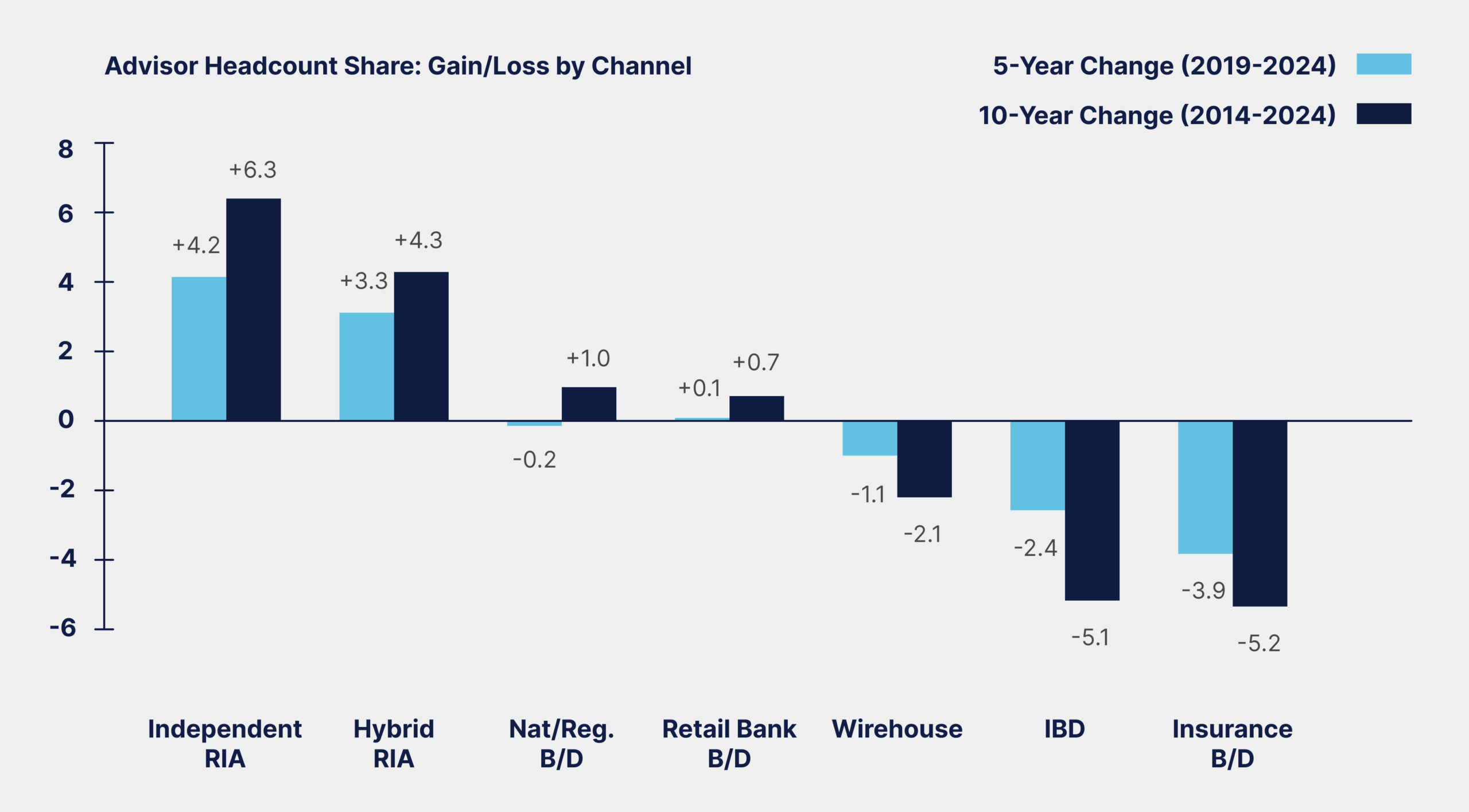
From 2014 to 2024, independent RIAs increased their share of advisor headcount by 6.3 percentage points and hybrid RIAs by 4.3 percentage points, while wirehouses, insurance broker-dealers, and IBDs lost share. For 2025, independent RIAs were projected to post a $161.9 billion net gain in advisor AUM, while wirehouses were projected to post a $292.8 billion net loss.
This is not simply a temporary recruiting cycle. It is a longer-term reallocation of talent toward business models advisors increasingly perceive as more entrepreneurial and aligned with their long-term interests.
How the Valuation Gap Is Accelerating Advisor Movement
The economics behind that reallocation are becoming far more visible. Traditional wirehouse-to-wirehouse recruiting packages can offer 3x to 4.5x production (revenue), generally taxed as ordinary income. By comparison, total deal consideration for a team transitioning to an RIA or an adjacent business model could command a valuation premium of 200% to 300% or more relative to those packages. On an after-tax basis, the difference can widen even further when the RIA transaction consideration qualifies for long-term capital gains treatment.
Wirehouse and captive advisors are beginning to learn en masse about this significant difference in valuation, deal structure, and tax treatment, which should accelerate the trend of advisors transitioning to RIA and hybrid firms. The independent channel has also become a much more credible destination for large and sophisticated advisory businesses. Advisors are no longer asking whether independence is viable; they are asking which independent model gives them the best combination of economics, resources, autonomy, technology, and growth opportunities. Cerulli reports that 71% of all advisors would choose an independent channel if they were to switch firms, and that 97% of independent RIA advisors surveyed would choose another independent RIA if they were to switch firms, a strong indication of the channel’s established popularity and staying power.
What Key Advisors Want From the Firms They Join
For RIA owners, the Great Reshuffle does not end when an advisor joins the firm. Retention has become much more than a compensation issue. Compensation still matters, but key advisors increasingly evaluate the entire employee and ownership proposition: Can I build something here? Do I have meaningful autonomy? Am I being given the resources to grow? Is there a clear path to leadership and ownership? Is the technology and infrastructure keeping pace with what my clients expect?
That is especially important for high-performing advisors who have developed their own books and understand the value of the enterprise they are helping create. They want to participate in that value creation rather than simply being compensated for production.
RIA owners are also increasingly recognizing that equity is not simply a succession tool; it is a talent-retention and leadership-development tool. Historically, many founders viewed their equity primarily as the asset they would monetize at retirement. Today, more founders are asking how they can use ownership to attract advisors and bring the next generation into the economic future of the firm while they are still actively involved.
The lesson for owners is that retention needs to be proactive. The best firms are not waiting for a key advisor to receive an outside recruiting offer before discussing career progression, economics, or ownership. They are creating a compelling reason to stay well before the advisor starts thinking about leaving or hearing about alternative paths forward.
The ECHELON Insight
At ECHELON, we believe one of the most compelling opportunities in today’s Great Reshuffle is helping successful wirehouse and captive advisors unlock the significant enterprise value they have built over their careers. Historically, advisors considering a transition have often focused on moving from one traditional brokerage platform to another, negotiating recruiting packages and upfront transition incentives. While those economics can be attractive, they typically represent only a fraction of the wealth creation potential available through partnerships with independent businesses.
Today, the emergence of well-capitalized RIA platforms and strategic partners has fundamentally changed that equation. Advisors can transition to independent business models through partnerships that offer substantial upfront liquidity, meaningful equity ownership, and much more attractive tax treatment. These transactions can deliver significantly higher valuations than traditional wirehouse or captive recruiting arrangements, while providing advisors with greater autonomy, enhanced flexibility, and access to the infrastructure and resources needed to serve their clients and grow their businesses.
At ECHELON, we help advisors evaluate, structure, and execute these transitions by identifying the right strategic partners, creating a competitive process, and maximizing the financial and strategic value of their businesses. Our focus extends beyond securing attractive upfront economics to helping advisors establish long-term partnerships that align ownership, growth opportunities, succession planning, and client service.
Interested in discussing your strategic objectives and what a partnership could mean for your business? I would welcome the opportunity to connect. Contact Brett at bmulder@echelon-partners.com.