

Years ago at UCLA Anderson, I studied under Professor Eric Flamholtz. He had a gift for cutting through the romance of entrepreneurship, and one lesson from his classroom has shaped how I have advised firms as a CEO and founder myself. The skills that make a firm successful at one size are almost never the skills that take it to the next.
Flamholtz built a career around that idea. His book, Growing Pains, and his firm, Management Systems Consulting, gave it a framework. Decades later, the patterns he described remain remarkably relevant across the RIA industry.
One of the privileges of working with wealth management firm leaders is the opportunity to observe firms at different stages of their development. While every organization is unique, many of the most successful firms encounter similar inflection points as they grow.
In many cases, these transitions are accompanied by what are commonly referred to as growing pains.
The phrase itself can be misleading. It suggests that something is wrong. More often, what we observe is a successful business reaching a point where the organization must evolve alongside the growth it has achieved.
The Six Stages of Scaling an RIA
As firms grow, the demands placed on the organization change. A leadership team overseeing a few employees faces different challenges than one managing dozens. A firm serving hundreds of client relationships operates differently than one serving thousands. The work of making decisions and holding people accountable becomes harder, and developing talent becomes a discipline in its own right.
Drawing on Professor Flamholtz’s work on organizational development, I often think about wealth management firms progressing through a series of distinct stages of scale.
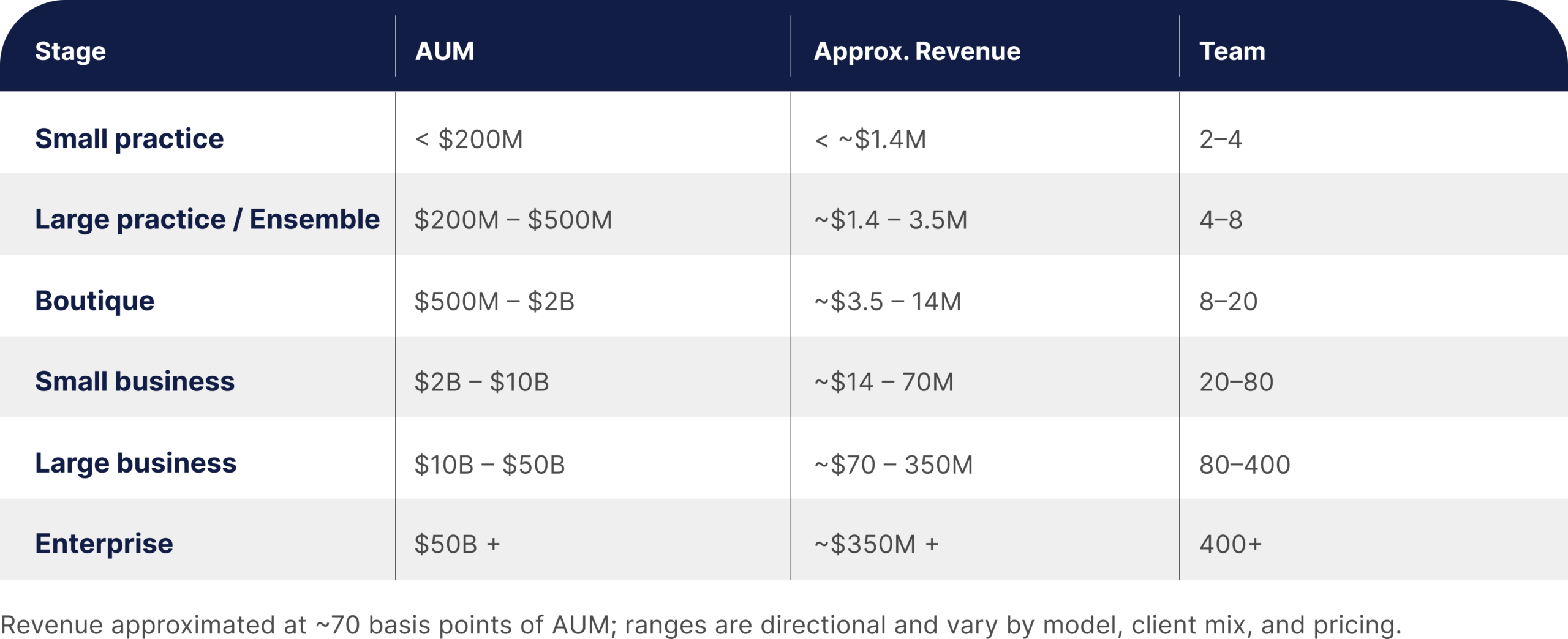 The exact path varies, but the underlying dynamic is consistent. Assets grow and teams expand, and before long a founder is running a business that looks materially different from the one they built only a few years earlier.
There is a structural reason growing pains follow. As firms grow, organizational demands tend to increase faster than most leaders anticipate. Each new client, employee, service offering, and regulatory requirement introduces additional layers of coordination and decision-making. Over time, leaders may find themselves spending more energy managing the business than building it. Growing pains are often the visible signs that the organization’s infrastructure has not yet evolved to support its next stage of growth.
Looking Beyond the Symptom
One pattern we see repeatedly is that growth changes the nature of leadership. In the early years, a firm’s success is closely tied to its founder. Decisions happen quickly, relationships are personal, and much of what makes the business work lives in the judgment of a few people. There is nothing wrong with that. It is often exactly what allows the firm to grow.
The strain shows up later, and across the firms we advise it appears in consistent ways. A founder who once spent most of their time with clients now spends their days resolving internal issues. A leadership team that used to decide quickly finds itself revisiting the same conversations. New hires join, yet capacity never seems to increase. Revenue keeps climbing while profitability does not. And a few key employees quietly become so important that their departure would put real revenue at risk.
Viewed individually, these look like unrelated problems. More often, they are symptoms of a business that has reached a new level of complexity faster than its structure has caught up. A founder pulled into every decision usually does not have a time-management problem; leadership has not been distributed. Difficulty integrating new hires is rarely a recruiting problem; the firm grew without making its process and cultural expectations explicit. Operational bottlenecks are not always technology problems; more often they point to a need for clearer structure and better workflows.
The most common and most expensive of these is people and culture. Under growth pressure, firms built on talent begin hiring for capacity over excellence, and the erosion is slow enough to miss. The same pattern repeats elsewhere: governance that lags headcount, finance that stays informal, a sales effort that adds products instead of better client outcomes, portfolios that grow complex when simpler would serve clients better, service that slips as client counts climb, and technology that gets underfunded exactly when complexity compounds. Left unaddressed, these challenges compound, and what begins as internal friction becomes a constraint on the firm’s ability to sustain its next stage of growth.
Building for the Next Stage
If those are the symptoms, the more useful question is what to build in response. The most common mistake is to address each issue where it surfaces. In most cases the cause sits elsewhere in the organization, which is why treating symptoms one at a time rarely produces lasting improvement.
We encourage leaders to begin with the five areas that determine whether everything else functions, in a deliberate order: leadership, strategy, culture, structure, and systems. Nearly every growing pain we diagnose traces back to one of them, and they tend to fall behind in that sequence. The order is not incidental. A systems investment seldom holds before the leadership above it is sound, so building out of order is a common way for firms to spend capital without resolving the underlying problem.
Once a specific issue has been isolated, the response follows a disciplined sequence:
1. Research the cause and scope. Establish what is happening, why, how often, and what it is costing the business.
2. Establish its priority. Weigh the issue against the other goals, risks, and investments competing for attention.
3. Develop and compare alternatives. Identify real options and assess what each requires to execute.
4. Decide and commit. Select a path, communicate it clearly, and act with enough urgency to prevent the problem from compounding.
5. Assign ownership. Name a single owner with defined outcomes, supported by genuine accountability.
The ECHELON Insight
From our seat, advising hundreds of firms, the pattern is unmistakable. Two firms with comparable financial results can command very different valuations, and the gap is almost always organizational maturity. The growing pains that most reduce enterprise value are rarely market-driven. They are self-inflicted, and they appear in the multiple long before they appear in the financials. Revenue growth alone does not determine enterprise value. The strength of the organization behind that growth often matters just as much.
This is the heart of what Flamholtz taught. A firm rarely stalls because its market weakens or its people stop working hard. It stalls because the organization beneath the business stops keeping pace. Flamholtz’s central insight was not that growth creates problems. It was that growth creates new organizational requirements. Firms that recognize those requirements early tend to navigate scale more successfully than those that wait until the strain becomes visible. Growing pains are inevitable; persistent growing pains are not. The firms that endure are the ones that read the signals early and build ahead of them, almost always well before circumstances force the issue.
If you would like to discuss where your firm sits on its path to scale, or what these dynamics may mean for your future growth, succession, or enterprise value, I would welcome the conversation. You can reach me directly at dseivert@echelon-group.com.