
A Market Increasingly Defined by Scale and Ability to Invest Ahead
The wealth management industry is entering a new phase, often referred to as Wealth 3.0, where scale, capital, and capabilities are no longer advantages; they are requirements. Success in this era is defined by how intentionally firms align their strategy, ownership structure, and capital to compete.
If I were a CEO in the industry today, the central question I’d be asking is: “Is my current model structurally equipped to compete and what trade-offs am I willing to make to accelerate change?”
From our purview at ECHELON, we observe three critical shifts:
- Consolidation of Growth: Growth is no longer evenly distributed. It is concentrating among firms with the scale and capital to invest ahead of demand.
- An Expectations Supercycle: Clients are increasingly informed, empowered, and technologically enabled, raising the bar for advice, responsiveness, and outcomes. Private clients are beginning to expect the same sophistication, integration, and accountability as institutional investors.
- The Operating Threshold: Competing now requires sustained investment in talent, technology, and multi-disciplinary service models.
Outcomes Are Beginning to Diverge
The gap between “scale players” and the average firm is widening into a structural chasm, not a cyclical one. The ECHELON top 50 acquirer benchmark shows an annual AUM growth of ~38%, compared to just 11.3% for the average RIA, representing a 330% growth premium.
Referral networks, M&A processes, and organic growth channels are increasingly dominated by firms with the capital and infrastructure to invest ahead of the curve. Service expansion, delivering an institutional-grade experience to private clients, is no longer a differentiator; it is the price of admission.
Capital is not a differentiator in itself; it is a magnifying glass that amplifies a firm’s existing ability to operate and compete in this new paradigm.
Evaluating Strategic Paths: The Decision Pivot
Management teams must move beyond incremental thinking. The choice of path is not just a destination, but a series of pivots regarding how you fund your growth and who you align with. To guide this decision, we utilize the following framework to align your priorities:
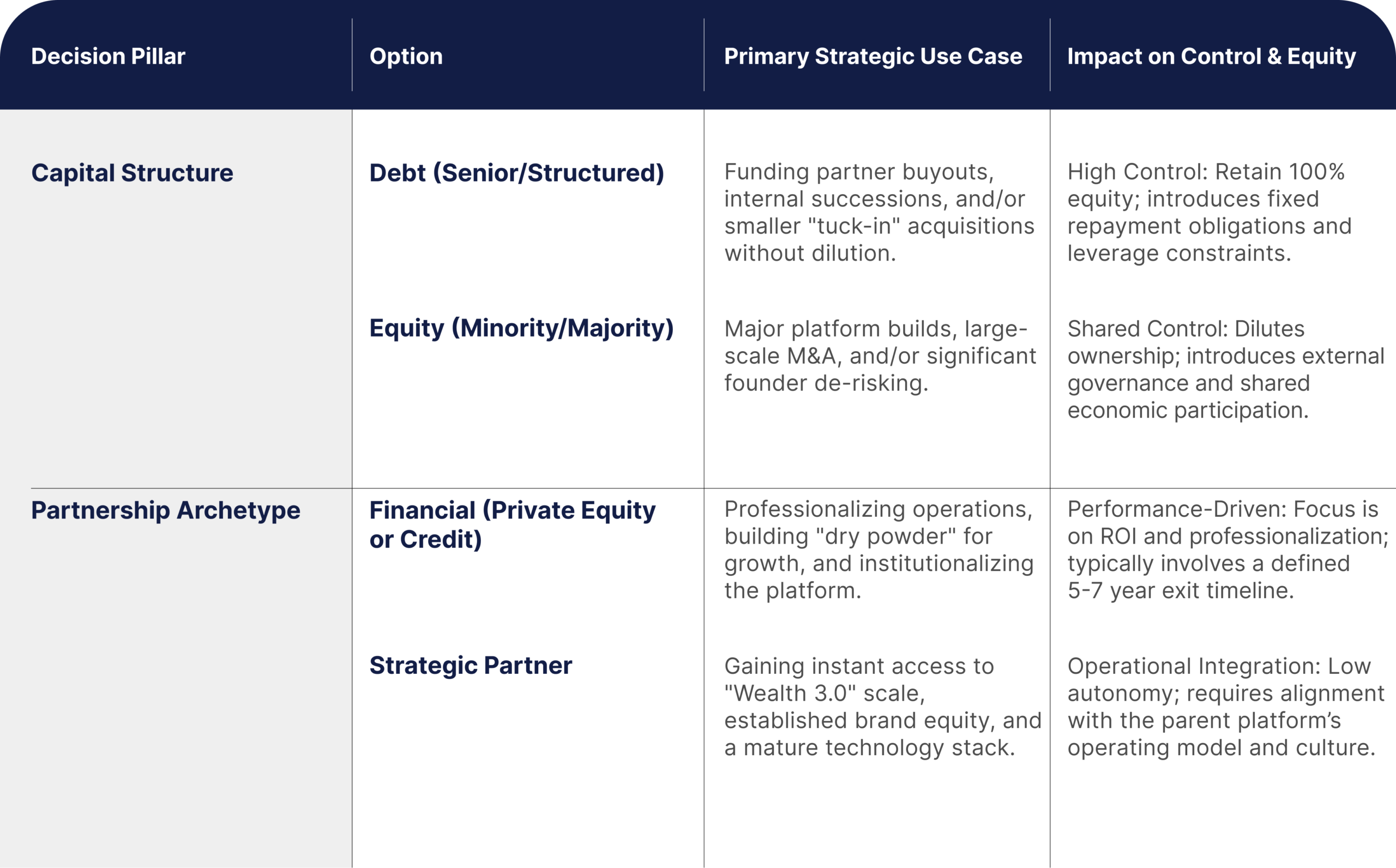
Aligning Growth, Liquidity, and Control
These three dimensions, Growth, Liquidity, and Control, do not move in perfect alignment. Advancing one typically introduces constraints on the others and, in practice, defines your operating model.
- Accelerated Growth typically requires external capital and a willingness to share upside.
- Maintaining Control preserves your unique culture but may limit the pace of expansion.
- Creating Liquidity necessitates new structures for governance and long-term alignment.
Where clarity on these priorities is absent, complexity builds without a corresponding shift in performance. For management teams, this is not an abstract framework; it is a set of practical decisions that shape your trajectory. A useful diagnostic is to ask:
- Is our current model equipped to meet the rising operating threshold, or are we falling behind?
- Are we proactively investing ahead of client expectations, or reacting to them as they evolve?
- Is our ownership and capital structure enabling us to execute on our growth strategy, or constraining it?
- Are we deliberately choosing our path, or defaulting into it through incremental decisions?
The ECHELON Insight
There is no universally “correct” path. But there is a clear distinction between firms that choose deliberately and those that drift into a structure by default.
In our experience, outcomes are driven less by a transaction itself and more by the clarity of intent behind it and the discipline to execute against it.
Interested in discussing how ownership and capital decisions align with your firm’s long-term objectives? I would appreciate the opportunity to connect. Contact Barnaby at baudsley@echelon-partners.com.